Monday, February 6, 2012

Roasted Pork Loin with Root Vegetables

"One of the very nicest things about life is the way we must regularly stop whatever it is we are doing and devote our attention to eating."
~Luciano Pavarotti and William Wright, Pavarotti, My Own Story


This is a meal worthy of a holiday setting, yet also sits well at an informal table. It is hearty and filling and fills the house with a rich aroma usually only found at Thanksgiving or Christmastime.

For the sauce:
6 bacon slices, cut in half
6 cups chicken broth
1 1/2 cups dry white wine
1/2 cup lingon berries jelly or preserves
1 1/4  tsp minced fresh rosemary
3 tablespoons unsalted butter

Fresh rosemary is like a tiny piece of heaven and it is so easy to grow.
Cook the bacon in a large, heavy saucepan over medium heat until crisp. Transfer the bacon onto paper towels to drain. Discard the drippings from the pan. Put the chicken broth, wine, lingon berries jelly or preserves, and rosemary in the pan. Boil until reduced to about 2 1/2 cups. Return the cooked bacon slices to the sauce and boil until the liquid is reduced to 1 1/3 cups. Strain the sauce into small saucepan. Add the butter. Whisk over low heat until sauce is smooth, about 2 minutes. Season with salt and pepper.

The sauce can be prepared a day ahead. Cover and refrigerate.

For the rub:
2 tsp cumin seeds
2  tsp coarse salt
1  tsp black peppercorns
1  tsp black cardamon seeds (from about 30 whole green or white cardamon pods)

The cumin seeds, salt, peppercorns and cardamon all need to be finely ground.


I use a mortar and pestle to grind the spices.
Finely grind the cumin seeds, salt, peppercorns and cardamon - I use a mortar and pestle, but a coffee grinder works very well. 

For the roast and vegetables:
1 4-pound to 4 1/4-pound center-cut boneless pork loin
1 tablespoon olive oil
2 1/2 pounds large russet potatoes (about 5), peeled, halved lengthwise, cut into 2-inch pieces
1 1/2 pounds large parsnips (about 4), peeled, cut into 2-inch pieces, thick portions halved lengthwise
1 1/2 pounds large carrots (about 4), peeled, cut into 2-inch pieces, thick portions halved lengthwise
8 large garlic cloves, peeled
3 large fresh rosemary sprigs
6 Tbs olive oil

Place the pork in 13x9x2-inch glass baking dish. Rub the olive oil over the entire surface of the pork. Now rub on the spice mixture, massaging the spices into the pork. Cover and refrigerate for four hours - or up to one day.


Position your oven rack in center of the oven. Preheat to 400°F.

Place potatoes, parsnips, carrots, garlic and rosemary in a large roasting pan - this pan will be accommodating the the pork loin as well so it needs to be very large. Drizzle the vegetables with five tablespoons of the olive oil. Sprinkle with salt and pepper. Roast on center rack 45 minutes, turning vegetables occasionally.


Remove the roasting pan from oven. Pushing the vegetables to sides of the pan, clear a space in the center for the pork. Place the pork in center of pan.


Return the pan to the center rack and cook until the vegetables are brown and cooked through and pork has a center temperature of 150°F, about 1 hour. Turn the vegetables occasionally.


Remove the pan from oven and let stand 10 minutes. Rewarm the sauce over low heat, whisking constantly.


Place pork roast in center of large platter and surround with all the vegetables.


Serve and enjoy.


This will feed a hungry family of six.

Monday, January 9, 2012

Purple Smoothie

Blueberries! Pomegranates! Bananas! Oh my!


I do like smoothies. 

Showing up in the 1930s as pureed fruit drinks based on recipes that originated in Brazil, the smoothie (or smoothee, or smoothy) has steadily gained popularity throughout the world. In the 1940s, Waring Blendor began including recipes for smoothies in their cookbooks, including such exotic flavours as banana and pineapple. They enjoyed a significant surge in popularity with the hippies during the 60s, appealing to the healthful, macrobiotic crowd. By the 1970s they were a staple of health food restaurants and even smoothie shops.

They are sweet, fruity and can be very healthy. What's not to like about that?

This is a simple recipe that includes three of my favorite flavours: bananas, blueberries and pomegranates. 


Purple Smoothie
1 cup yogurt
1 banana
1/2 cup blueberries, frozen
1/2 cup pomegranates
1 raw egg
1 Tbs flax seed

If you don't care to use a raw egg, you can choose the protein of your choice, such as whey or soy protein powder.

For a little extra sweetness, you can add 2 tsp of honey or sweetener of your choice.

Put all the ingredients in a blender (I use a Vitamix).


Blend well.

With loads of pterostilbene, anthocyanins, proanthocyanidins, resveratrol, flavonols, and tannins, this is a healthy and tasty snack or addition to a good meal. And it is easy enough to double it up if you want to share this incredible smoothie with someone.

Monday, December 5, 2011

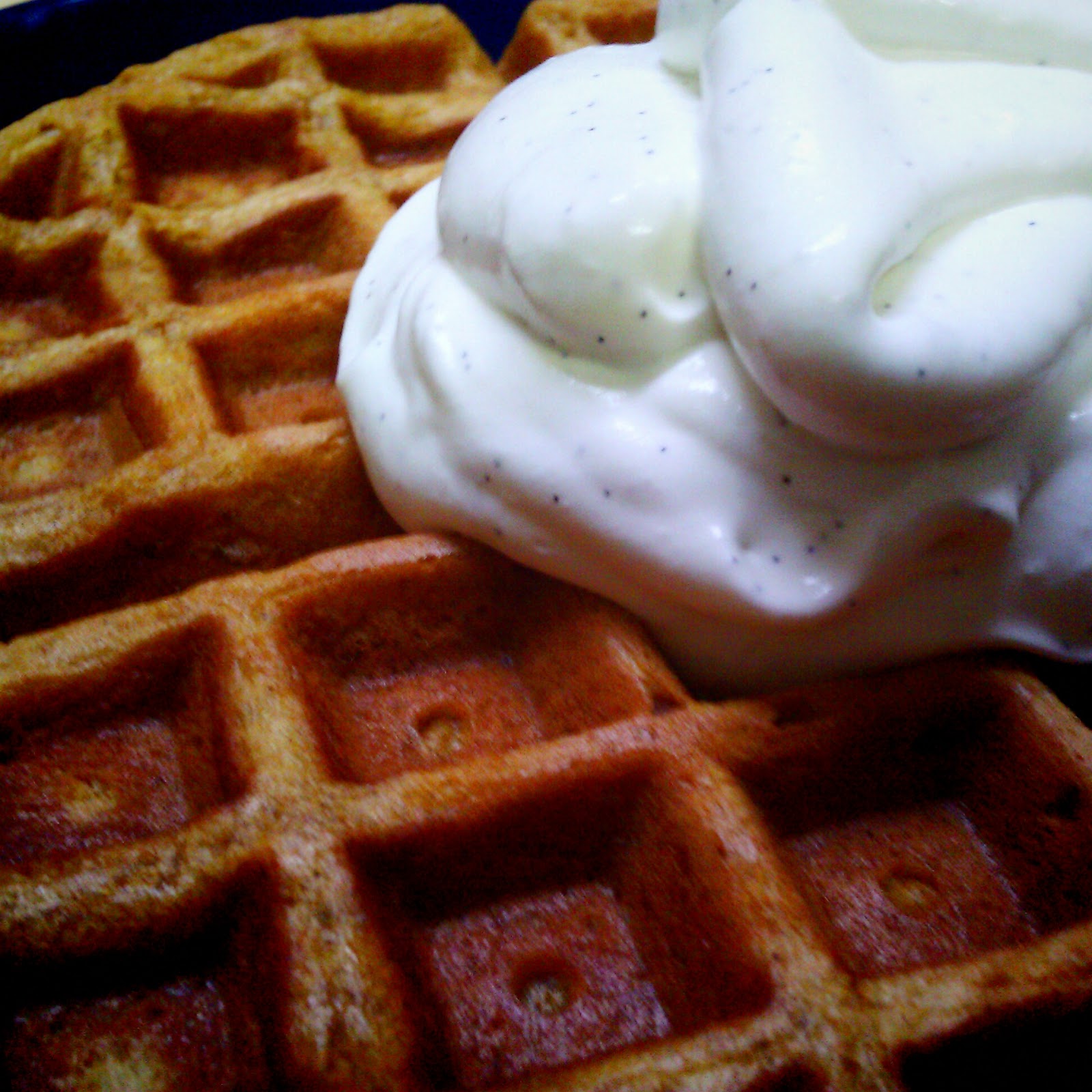
Gingerbread Waffles

Come sit at my table and share with me
Warm gingerbread cookies and cinnamon tea

There is something spectacularly Christmas-y about gingerbread. From the treacly spice cake of English gingerbread to the crunchy yet delicate Piparkakut of Finnish gingerbread to the Lebkuchen houses of German gingerbread, the smell of ginger and cinnamon and nutmeg and molasses baking together summons up memories of Christmases from childhood. 

Brought to Europe in 992 by an Armenian monk by the name of Gregory of Nicopolis, gingerbread has enjoyed lasting popularity in its many forms throughout Europe and in America and is especially treasured at Christmastime when the weather turns colder.

This is a breakfast version of the beloved treat and has the same heavenly aroma as you bake it. The rich, spicy flavour goes very well with the delicate vanilla of homemade whipped cream.


Vanilla Bean Whipped Cream
2 cups heavy cream
1 vanilla bean
1/4 cup powdered sugar

Place the cream in a medium bowl. Cut the vanilla bean in half lengthwise and scrape out the seeds. Add the vanilla seeds to the cream and whisk gently to combine. Cover the mixture and refrigerate for one hour.


Beat the cream at medium speed with an electric mixer or use a wire whisk until soft peaks form. Slowly add the sugar and continue to beat just until stiff peaks form. Do not over whip.


Cover and refrigerate until your waffles are ready to be served.

Gingerbread Waffles
3 cups all-purpose flour
4 tsp baking powder
2 tsp ground cinnamon
2 tsp ground ginger
1/2 tsp grated nutmeg
1/2 tsp salt
4 large eggs
2/3 cup packed dark brown sugar
1 16-ounce canned pumpkin puree
1 cup milk
1/2 cup molasses
1/2 cup (1 stick) melted butter

Preheat the waffle iron.

In a large bowl combine flour, baking powder, cinnamon, ginger, nutmeg and salt.


In a medium bowl, beat the eggs and brown sugar until fluffy, then beat in the pumpkin, milk, molasses and melted butter.


Stir the wet ingredients into dry ingredients until just moist. Do not over-stir.


Brush the waffle iron with a little melted butter. Add batter according to the waffle iron manufacturer's directions.


My waffle iron takes just under a cup of batter.


Bake until a rich, golden brown and slightly crisp.


Serve immediately, topped with the fresh vanilla whipped cream.


This makes about 8 to 10 large waffles.

If you don't have a waffle iron, no need to miss out on the yumminess. It is easy to convert a waffle batter into a pancake batter. With waffles, you are going for crisp on the outside and light and fluffy on the inside; but with pancakes you want a moist, cake-like texture throughout.

Eliminate the melted butter. Reduce the baking powder to 3 tsp. Once the batter is mixed up, if it seems too thick, add a little bit of extra milk. You don't want the pancakes to be too thick as they will remain uncooked in the middle. Pour 1/3 cup of batter at a time on a medium heat pan or griddle. Flip the pancake when you begin to see plenty of bubbles at the top of the batter.


Wednesday, November 23, 2011

Lasagna

"Once again, my life has been saved by the miracle of lasagna." 
~Garfield

As the weather gets colder my cooking shifts to heavier, heartier fare. Stews and baked dishes make regular appearances. Not only are they warming and filling, they also make for wonderful leftovers that get better and better each time they are reheated. A favourite in our house is lasagna. This recipe, although more time consuming than using a canned red-sauce, is well worth the effort. And the amount of sauce you end up with is more than you need for the lasagna itself so the leftover can be used as a sauce for spaghetti or other pasta dish.

Lasagna
1 pound ground beef
3/4 pound ground pork
1 Tbs butter
1 Tbs olive oil
1/2 medium onion, minced
6 cloves garlic, crushed
1 (28 ounce) can crushed tomatoes
2 (6 ounce) cans tomato paste
2 (6.5 ounce) cans canned tomato sauce
1 Tbs sugar
1½ tsp dried basil leaves
1 Tbs salt
1/4 tsp ground black pepper
4 Tbs chopped fresh parsley
12 lasagna noodles
16 ounces ricotta cheese
1 egg
1/2 tsp salt
1 pound mozzarella cheese, sliced
3/4 cup grated Parmesan cheese

Tip: chopping or mincing an onion is much easier if you make parallel slices down through the onion , but not all the way through, and then make another set of parallel slices perpendicular to those, again almost all the way through. You can then turn the onion on its side and cut through for perfect pieces.

In a large pan, cook the ground beef and ground pork over medium heat until lightly browned. Drain off excess grease.


In a Dutch oven, melt butter and olive oil. Add the onion and garlic and saute until transparent. Add browned meat and stir in crushed tomatoes, tomato paste and tomato sauce. 


Season with the sugar, basil, 1 Tbs salt, pepper, and 2 Tbs parsley.


Simmer, covered, for about 1½ to 2 hours, stirring occasionally.

Prepare the noodles as per package directions.


In a mixing bowl, combine ricotta cheese with egg, remaining parsley and 1/2 tsp salt. Mix well.

Preheat oven to 375° F.


Cut the mozzarella cheese into thick slices.


Spread 1½ cups of the meat sauce in the bottom of a 9-inch by 13-inch baking dish. Arrange six noodles lengthwise over the meat sauce. Spread one half of the ricotta cheese mixture on top of the meat sauce. Top with a third of mozzarella cheese slices. Spoon 1½ cups of the meat sauce over mozzarella, and sprinkle with 1/4 cup Parmesan cheese. Arrange remaining six noodles lengthwise over the meat sauce. Repeat layers, and top with remaining mozzarella and Parmesan cheese.


Cover with foil.

Bake at 375° F for 25 minutes. Remove foil, and bake an additional 25 minutes.


Friday, November 18, 2011

Holiday Harvest Loaf

"Gratitude unlocks the fullness of life. It turns what we have into enough, and more. It turns denial into acceptance, chaos to order, confusion to clarity. It can turn a meal into a feast, a house into a home, a stranger into a friend. Gratitude makes sense of our past, brings peace for today and creates a vision for tomorrow."
~Melody Beattie

Like many Americans, each year our family gathers for Thanksgiving. This is a big affair including what most would call extended family. The host - usually my aunt - provides the turkey and in the great American tradition of the potluck, everyone else brings all the fixings, side dishes and desserts.

For many years now - more than a decade! - I have volunteered to bring the bread. This is not surprising. I love making bread. In fact, I have been told I should have a bread blog, rather than a cooking blog. Perhaps so.

I don't make rolls or traditional loaves for the feast; but rather I take the opportunity to make an elegant and "fancy" bread that adds to the splendor of the meal. Here's the secret: it is not complicated and is certainly not hard to pull off. Yet the results are worth some accolades and a request for a repeat performance for next year.


Holiday Harvest Loaf
5½ cups all-purpose flour
2 packages active dry yeast
1 Tbs salt
¼ cup olive oil
1¾ cups water
1 beaten egg white
1 Tbs water

Making the dough is a pretty straightforward affair; it is a simple white flour dough. The artistry comes in the presentation.

Put the flour in a large bowl. Add the salt and yeast and mix well. Add the olive oil and then slowly add the water a little at a time, stirring with a spoon and picking up all the flour mixture.

Add enough of the water to make a soft, pliable dough. You may need to add a little extra water if the dough is too dry.

Turn the dough out onto a lightly floured surface and knead until it is smooth and elastic - about five to eight minutes. (If you have a Kitchen-Aid, put on the dough hook and let it knead the dough for about five minutes.)

Shape the dough into a ball. Put the dough into a lightly greased bowl, turning once to coat all sides of the dough. Cover and let it rest about an hour.

When the dough has about doubled in bulk, punch it down with your fist and turn it out onto a lightly floured surface. Cover and let rest about 10 minutes.


Here's where the real fun begins!

Take about a quarter of the dough and on a lightly floured surface roll out a rectangle about 16 inches long, 10 inches wide and about ½-inch thick. Use a little bit of flour on the rolling pin to keep it from sticking.


Using a knife, cut out a keyhole shape. You can use a small plate as a guide for the top, round end. Line a baking sheet with parchment and carefully transfer the keyhole to it.


Take three small pieces of dough and roll them into long, thin pieces, about 8 inches long. Spread the strands in front of you and join then at the top end. Braid them together, crossing the left strand over the middle strand to the right and then the right strand over the middle strand to the left.


Carefully raise the round end of the keyhole and place the braid under it, centering it at the bottom of the circle. Press down the keyhole where the braid goes under it to flatten it out.


Hand roll out 20 to 30 pieces about 8 inches long and as thin as you can get them. Brush the bottom of the keyhole with a little water to get the dough tacky and lay out the thin dough strands from the place where the braid goes under the keyhole to the bottom.


When you have completely covered the base of the keyhole with the thin strands, fold in the two ends of the braid over the tops of the strands, crossing one over the other and pressing lightly to seal.


Using the remaining dough, make small, slightly elongated balls. Brush the round portion of the keyhole with a little water to make it tacky and place a row of balls around the outer edge. Continue to add balls to fill in the center.


If you have any leftover dough you can make a mouse with a long tail to add near the bottom of the strands.


Let the dough rest for about an hour.


Preheat oven to 375°F.

Brush the Harvest Loaf with a mixture of egg whites and 1 Tbs of water.

Bake for 30 minutes and then lower the temperature to 300°F and bake for an additional  30 minutes until the loaf becomes a rich, golden colour.

Remove from the oven and cool on a wire rack.


This isn't bread that you slice, but rather is best when torn off in pieces and enjoyed in small roll-sized pieces. Perfect for dipping in gravy or just smothered in butter.


Enjoy it. Share it.  As W.J. Cameron said, "Thanksgiving, after all, is a word of action."